Fun with \(\pi\), complex sums and symmetries, Pi Day 2026
It is that time of the year again, \(\pi\) day is celebrated every year on 14th March. I use the word celebrate, but there are no big parades down the roads, or midnight fireworks. A few enthusiasts on the internet celebrate their irrational affection to the irrational number. I have had a history of writing a letter on \(\pi\) and have previously written a few posts about calculating \(\pi\), surprising places where \(\pi\) is found, and how we exist inside the expansion of \(\pi\). This year, I will be talking about an interesting visualisation I found on the internet a while back and how our favourite irrational number has a role to play in it.
Never intersecting spirograph?
A few months ago, I had seen a post on the subreddit r/oddlysatisfying, it shows a plot of a complex number \(z(\theta)=e^{(\theta i)}+e^{(\theta \pi i)}\), for people who do not know about complex numbers, any complex number can be written as \(z=a+ib\) or equivalently \(z=\alpha e^{(i \theta)}\), where \(i\) is the imaginary number defined as \(\sqrt{-1}\).
The angle theta is the angle that the point makes in the complex plane with the real line and \(\alpha\) is the distance from the center. This is the radial or polar representation of complex numbers. The polar expression with \(\alpha=1\) is famously known as Euler's formula.
Thus, in the visualisation, we are summing two complex numbers, which represent rotation around different points. This is represented as two arms with same length. In each instant, if the first arm rotates by the angle \(\theta\), the second one rotates by an angle \(\theta \pi\). \(\pi\) thus is the orbital speed.
These visualisations remind me of spirographs. I remember, when I was in school, I used to have stencils with a circle with jagged edges that could rotate inside a bigger stencil cut out with gears/teeth on the inside, these would glide on each other and I would use a pencil to trace one point of the circle. This is similar to what is happening in the visualisation, the only difference is that in the reddit post the two rotations occur in the same direction, whereas in a spirograph the rotation is in opposite direction.
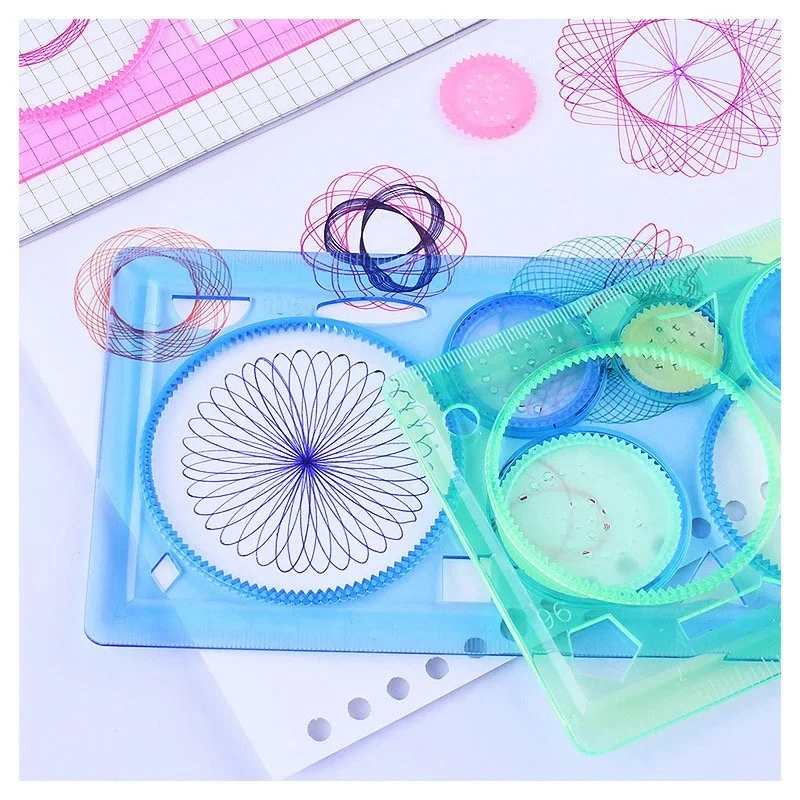
The most satisfying part using these stencils used to be the moment when the curve closed and I would start to retrace the already traced curve. This repeating pattern happens because of the speed of rotation, angular velocity. If the ratio of the two \(\theta\)(s) is a rational number, they will eventually become periodic. The least common multiple of the individual periods would give us the period of the resulting spirograph.
I think I will keep more discussion about spirographs for another post. Let us get back to the illustration in hand.
In fact, if we want to define these types of visualisations formally, these would be degree-2 complex fourier curve. They are also pretty close to epicyclic curve that Ptolemy used to model planetary motion in early Greco-Roman history.
Let us generalise the complex number sum, by taking the second parameter (taken as \(\pi\) above) as \(a\).
\[z(a,\theta)=e^{(\theta i)}+e^{(a \theta i)}\]We can now replace \(a\) and see how the trace of the value of \(z\) will look like.(Code to generate the plot in the appendix at the end of the post)
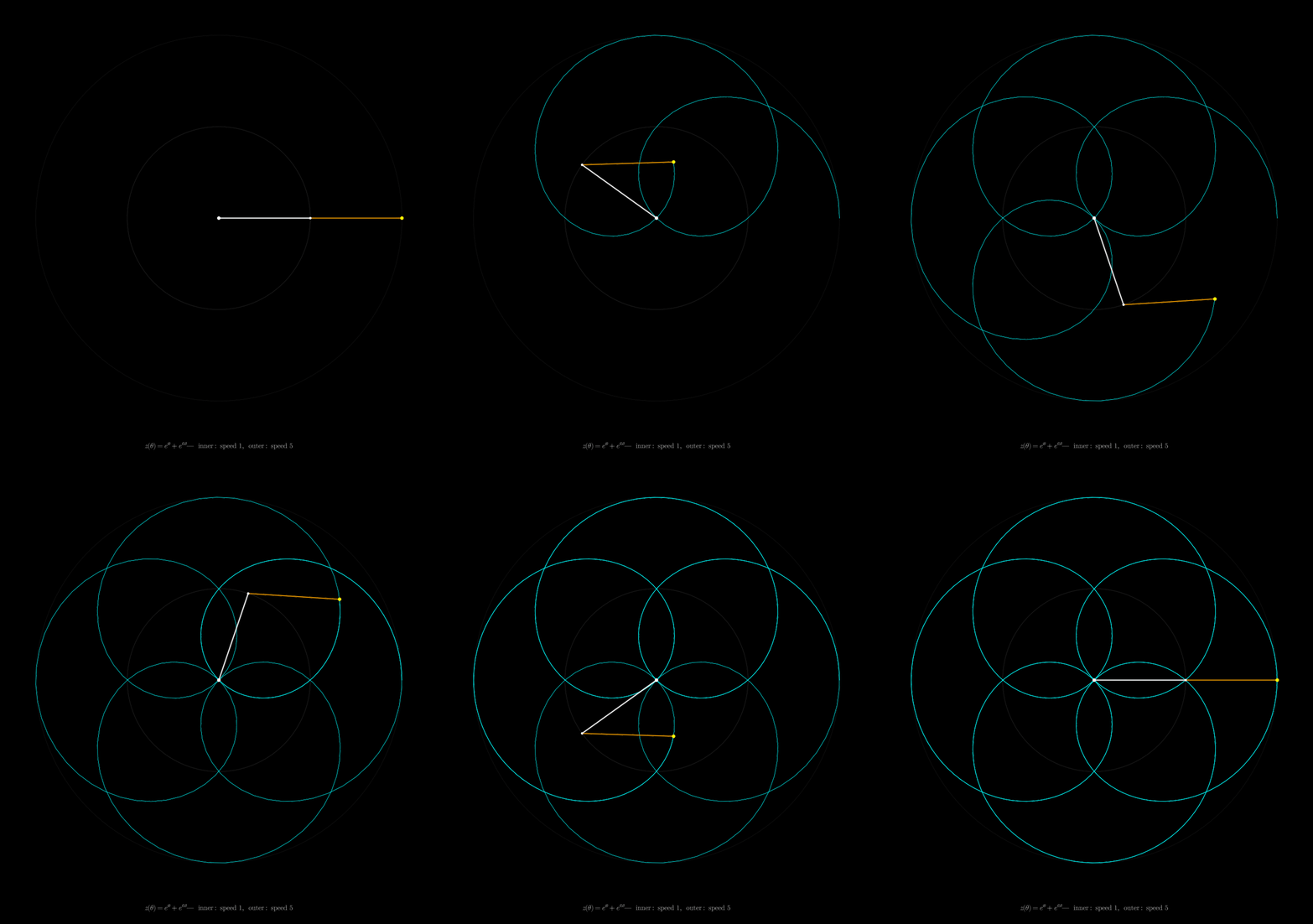
We see a very pretty, symmetric four leaf structure for \(a=5\). Notice, that after a \(2 \pi\) radians rotation around origin, we trace back the original path, much like our spirographs. This will be true for any rational ratio.
For \(a=1.5\), the path is looped back not after \(2\pi\) but \(4\pi\) radians. It creates a very interesting cusp shape that is pushed inside.
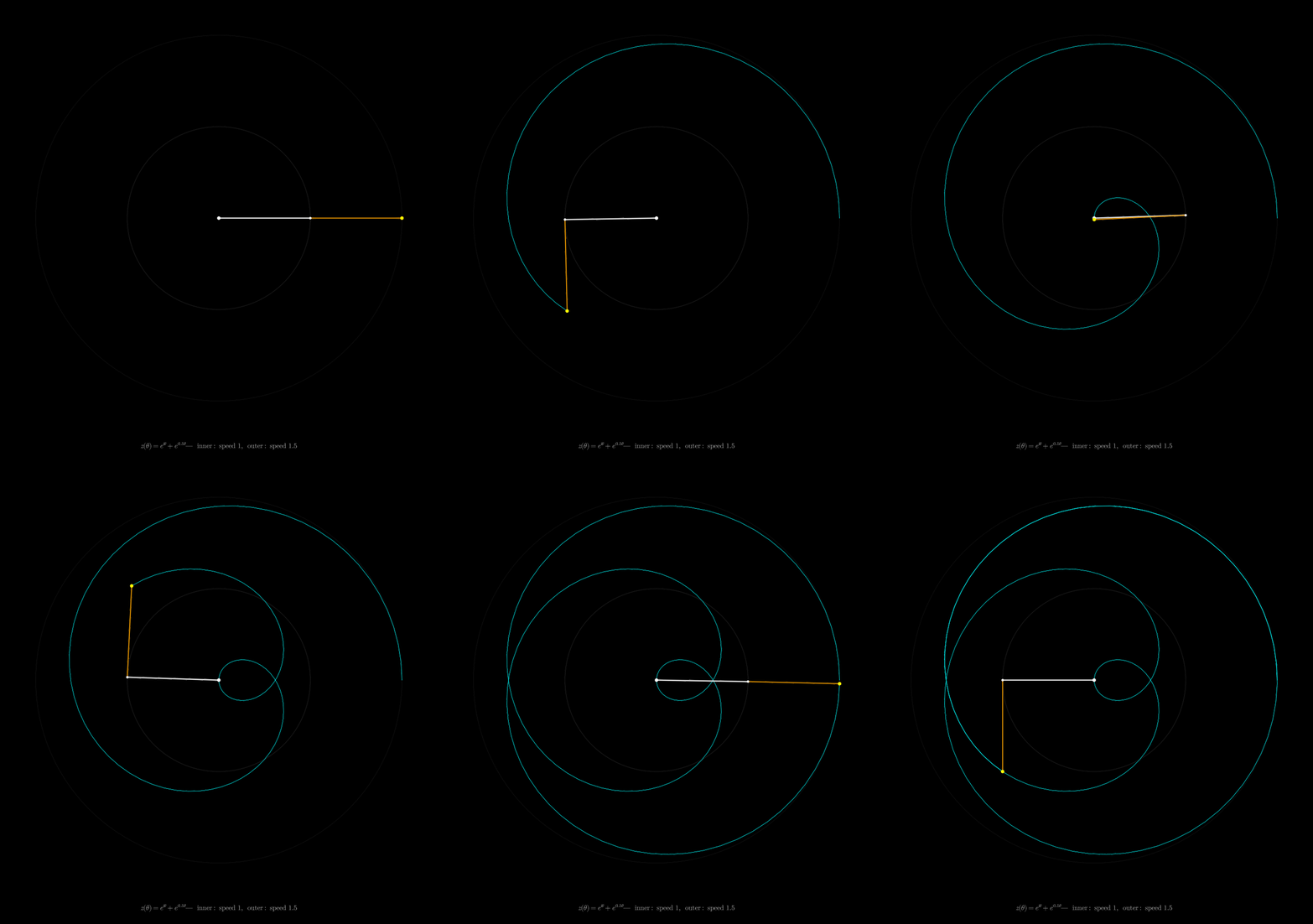
But eventually for each fraction we will find that the path will loop back in finite time. Check out the following embedded youtube video for four more cases with different integral \(a\) values. Notice how for \(a=n+1\), we get \(n\) leaf structures in the repeating diagrams. More on this later, when we try to formalise some results analytically.
Finally, let us see what will happen when we replace \(a\) by \(\pi\).
Let us be irrational: \(\pi\)
So, what happens when we use \(a=\pi\), or any irrational number as the angular speed for one circle? We end up with a never intersecting diagram as shown in the post above and as I have recreated it in the video below. Unmute the video for some classical music to go along with the pretty visuals. Notice the zoom and near miss at \(t=14\pi\).
As you can observe, you expect the periodic behaviour to begin after a while, but the curves do not coincide. In fact, at \(t=14\pi\), the curve almost reaches the starting point, but there is a very fine gap that is left, which later does not allow the curves to coincide. For \(\pi\) the curve is not periodic.
For \(e\) and \(\sqrt{2}\)
The following video shows the plots for \(z(e,\theta)\)(left) and \(z(\sqrt{2},\theta)\) (right). Showing that for other irrational numbers, there are no periodic representations.
The question now arrives, why is it that for rational numbers, we see periodic curves while for irrational there is no periodic behaviour. Let us formally study this complex sum of exponentials and try to answer this question.
Formal mathematical analysis
Let us look at the complex number \(z\) and try to study it by some mathematical analysis
\[ z(a,\theta)=e^{(\theta i)}+e^{(a \theta i)} = \cos (\theta) + i \sin(\theta) + \cos(a\theta)+i \sin\left(a \theta \right) \]Using standard trigonometric formulae:
\[ z(a,\theta) = 2 \cos \left( \theta \left( \frac{a+1}{2} \right) \right) \cos \left( \theta \left( \frac{a-1}{2} \right) \right) + i \ 2 \sin \left( \theta \left( \frac{a+1}{2} \right) \right) \cos \left( \theta \left( \frac{a-1}{2} \right) \right) \]Thus, we have:
\[ z(a,\theta)= 2 \cos \left( \theta \left( \frac{a-1}{2} \right) \right) e^{i \theta \left( \frac{a+1}{2} \right) } \]Note, we have a real scalar multiplied to the unit complex rotating number. So, \(2\left| \cos\left( \theta \left( \frac{a-1}{2} \right) \right) \right|\) is the amplitude whereas, \(e^{i \theta \left( \frac{a+1}{2} \right) }\) rotates the complex number.
We had earlier noticed that for \(a=n+1\) we have \(n\) leaves, now we can show why this is the case.
Let us try to find the roots of \(z\), ignoring the rotating part, \(z\) will be zero when \(\left| \cos\left( \theta \left( \frac{a-1}{2} \right) \right) \right|=0\)
This is true when,
\[ \theta \left( \frac{a-1}{2} \right) = \frac{ (2n+1)\pi}{2} \implies \theta = \frac{(2n+1)\pi}{a-1} \]For a=2, \(\theta=\pi,3\pi,5\pi,\cdots\), in which only \(\theta=\pi\) lies in one full period, \([0,2\pi]\). Similarly, for \(a=3\), only two zeros exist at \(\theta=\pi/2, 3\pi/2\). And for general \(a=n+1\), there are only \(n\) values of \(\theta\) in one period. When the value of \(z\) reaches zero, it is at the cusp. And thus each cusp corresponds to a leaf.
As we had mentioned before, for spirographs, the period at which the complete system repeats the pattern is the LCM of the two periods.
The first arm completes one circle or a period in \(\theta=2\pi n\), whereas the second arm with rotational speed of \(a\) closes after \(\theta = 2\pi m /a\). Here both, \(m\) and \(n\) are integers.
The period of oscillation is therefore, \(T=\text{lcm}(2\pi ,2\pi /a)\).
Assuming, \(a\) is a rational number which can be written as \(p/q\), then \(T=\text{lcm}(2\pi ,2 \pi q /p)\).
We want to find the lowest \(n\) and \(m\) for which:
\[2 \pi n = \frac{2\pi m q}{p} \implies n=\frac{mq}{p},\]since, \(q\) and \(p\) are integers and are the fractional representation of the rational number they do not have any common divisor. For \(n\) to be an integer, \(m\) has to be divisible by \(p\). Therefore the minimum value of \(m\) for which \(n\) is an integer is, \(m_{min}=p\). Finally, \(n_{min}=\frac{m_{min} q}{p}=\frac{pq}{p}=q\).
Therefore, the smallest orbit for \(a=p/q\), is
\[ T=2\pi n_{min} = 2\pi q\].
This expression shows why for our case for \(a=1.5\) the period \([0,2 \pi]\) did not repeat. We had to go till \(4\pi\) to get repeating patterns.
And finally, we can prove why \(\pi\) does not show any repeating pattern in this representation. \(\pi\) does have rational approximations, \(\pi \simeq 22/7\) is one of the most common ones that we learn in schools. There is a \(\sim 10^{-3}\) error bound in this depiction. Thus, when we look at \(T=2\pi \times 7 = 14 \pi\), we see that our trace crosses extremely close to the starting point, but not exactly at it. We get the next best rational approximation of \(\pi\) at \(333/106\). This suggests next close situation will occur at \(T=212 \pi\). And to actually see it in the visualisation, I would need to zoom more to see the smaller gap.
So, for \(\pi\) the period blows up to \(\infty\). And it fills the whole volume without repeating, and same goes for other irrational numbers for the same reason.
Comments
Appendix: Code for visualisation
Following code was used to generate animation in Julia
using GLMakie
a=3.15
# ── Figure Setup ────────────────────────────────────────────────────────────
fig = Figure(resolution = (900, 950), backgroundcolor = :black)
ax  = Axis(fig[1, 1],
    aspect          = DataAspect(),
    backgroundcolor = :black,
    xgridvisible    = false,
    ygridvisible    = false)
hidedecorations!(ax)
hidespines!(ax)

r1, r2   = 1.0, 1.0              # inner and outer rod lengths
θ_circle = LinRange(0, 2π, 300)

# Faint circle guides
lines!(ax, r1 .* cos.(θ_circle), r1 .* sin.(θ_circle),
       color = (:white, 0.12), linewidth = 1)
lines!(ax, 2r1 .* cos.(θ_circle), 2r1 .* sin.(θ_circle),
       color = (:white, 0.07), linewidth = 0.8)

# ── Observables ─────────────────────────────────────────────────────────────
t_obs  = Observable(0.0)
trail  = Observable(Point2f[Point2f(r1 + r2, 0)])  # accumulates every frame

arm1_seg = @lift [Point2f(0, 0),
                  Point2f(r1 * cos($t_obs), r1 * sin($t_obs))]

arm1_tip = @lift Point2f(r1 * cos($t_obs), r1 * sin($t_obs))

arm2_seg = @lift begin
    p = $arm1_tip
    [p, Point2f(p[1] + r2 * cos(a * $t_obs),
                p[2] + r2 * sin(a * $t_obs))]
end

tip_pt = @lift begin
    p = $arm1_tip
    Point2f(p[1] + r2 * cos(a * $t_obs),
            p[2] + r2 * sin(a * $t_obs))
end

# ── Drawing (trail first so arms render on top) ──────────────────────────────
lines!(ax,  trail,    color = :cyan,           linewidth = 0.8)
lines!(ax,  arm1_seg, color = (:white, 0.9),   linewidth = 2.5)
lines!(ax,  arm2_seg, color = (:orange, 0.9),  linewidth = 2.0)
scatter!(ax, [Point2f(0, 0)], color = :white,  markersize = 10)
scatter!(ax, arm1_tip,        color = :white,  markersize = 7)
scatter!(ax, tip_pt,          color = :yellow, markersize = 10)

# Formula label at the bottom
Label(fig[2, 1],
    L"z(θ) = e^{i\theta} + e^{i %$(a) \theta}  \text{—  inner: speed 1,  outer: speed %$(a)}",
    color = (:white, 0.65), fontsize = 14, tellwidth = false)

limits!(ax, -2.3, 2.3, -2.3, 2.3)
rowsize!(fig.layout, 2, 35)

# ── Record Video ─────────────────────────────────────────────────────────────
record(fig, "$(a)loop.gif",
       LinRange(0, 50π, 2000); framerate = 24) do θ
    t_obs[] = θ
    push!(trail[], tip_pt[])   # append new tip position to trail
    notify(trail)
end